

Over the last few weeks we saw the market digest the largest IPO in history, an event which will, one way or another, historically capture the current environment. The AI capital investment cycles continues forward and surging memory prices have had all sorts of direct and indirect impacts on the economy and markets. While investors have clearly moved on from the Iran conflict, its impact in certain areas of the global economy remains. Kevin Warsh’s first press conference highlighted a strong emphasis on market-based data points to inform policy.
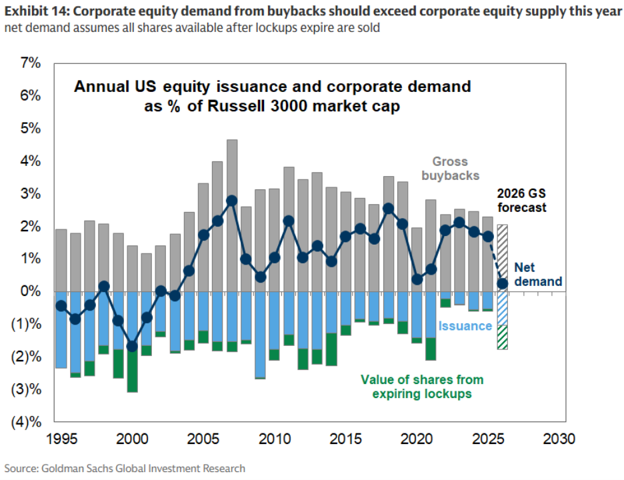
1. The AI capital investment cycle has transformed the world’s biggest companies from cash flow machines who bought back their own stock to capital intensive businesses looking for external funding. The recent SpaceX IPO encapsulates a wave of equity issuance coming in 2026. Corporate equity supply may exceed demand for the first time in over 20 years.
 Source: John Authers, Points of Return
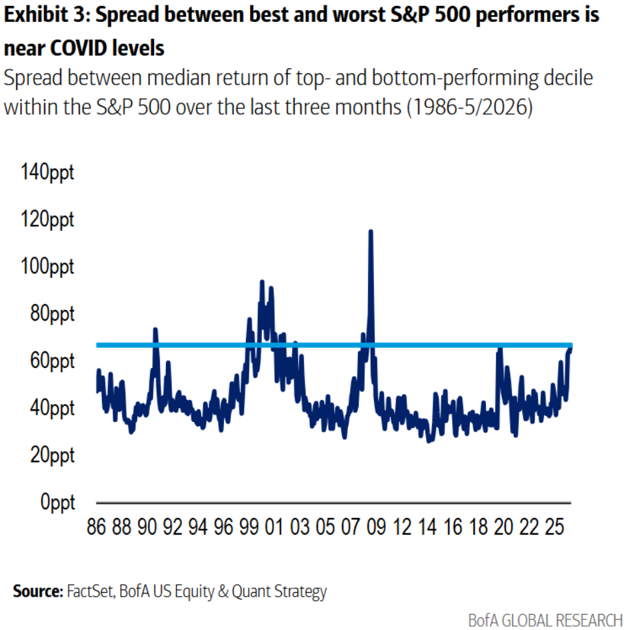
2. Market often concentrates at near-term peaks, recently this has come from the semi-conductor supply chain versus everything else.
 Source: John Authers, Points of Return
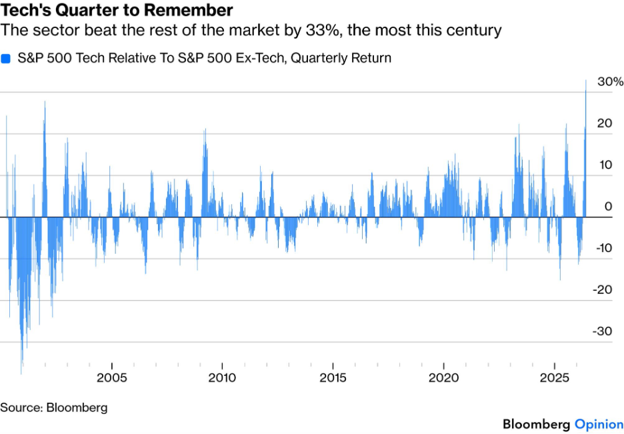
3. This concentration has been driven by Bonafide strong reported earnings in the quarter, although that strength has been heavily skewed by memory chip makers historic price increases.
 Source: John Authers, Points of Return
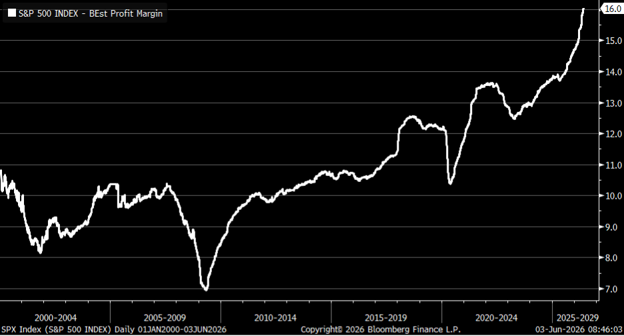
4. Memory paired with the sudden increase in Oil prices allowed S&P 500 profit margins to surge at a historically anomalous rate.
 Source: @kevrgordon via the Daily Chartbook on 6/3/2026
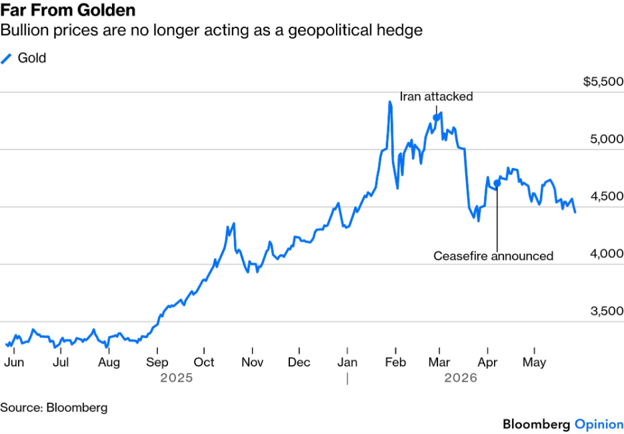
5. Once retail investors get excited about any asset class it’s behavior often changes.
 Source: John Authers, Points of Return
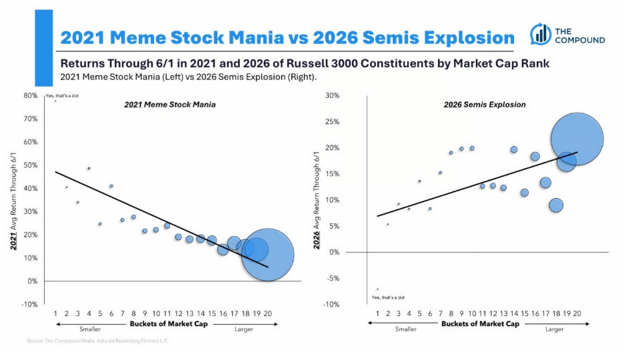
6. Perhaps some of the disinterest in Gold and other assets which were recently retail favorites is due to that fact that recently, exciting returns could be generated by some very large companies, namely the memory companies.
 Source: Matt Cerminaro, Chart Kid Matt via the Daily Chartbook on 6/2/2026
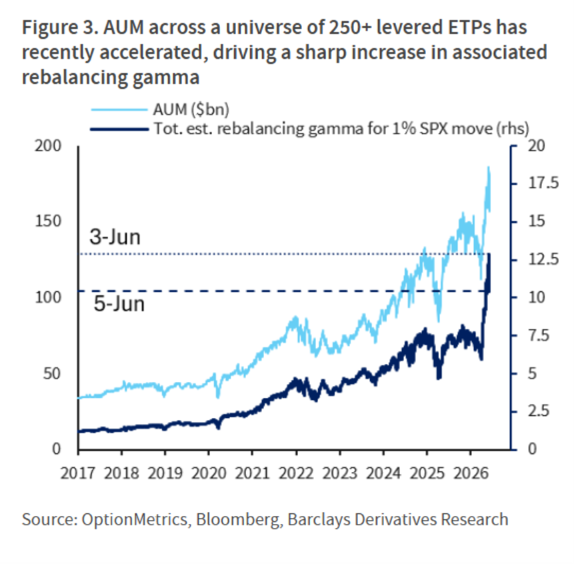
7. Increasing access to leverage will continue to create outsized moves in the market
 Source: Barclays via Bloomberg Odd Lots
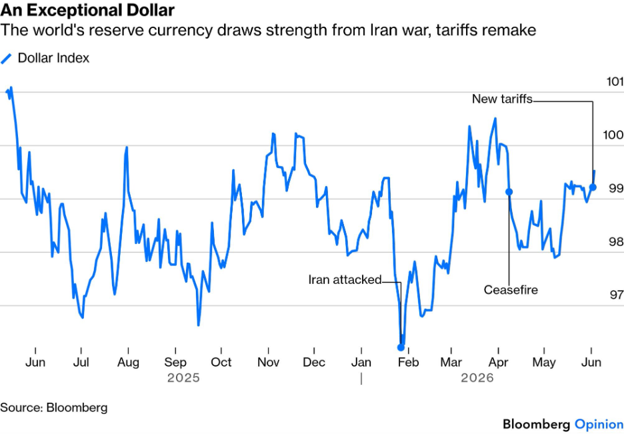
8. Investors have returned to the dollar in the wake of the Iran conflict
 Source: John Authers, Points of Return
9. The market has begun to punish the Mag 7 for seemingly being bullied by a bunch of commodity memory chip makers which years ago they might easily have re-created, but now are raising prices multiple hundred percent due to the Mag 7s own demand.
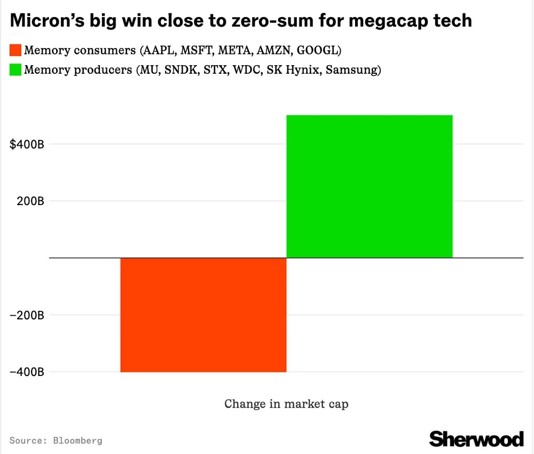 Source: https://x.com/LJKawa/status/2070229844172967964?s=20
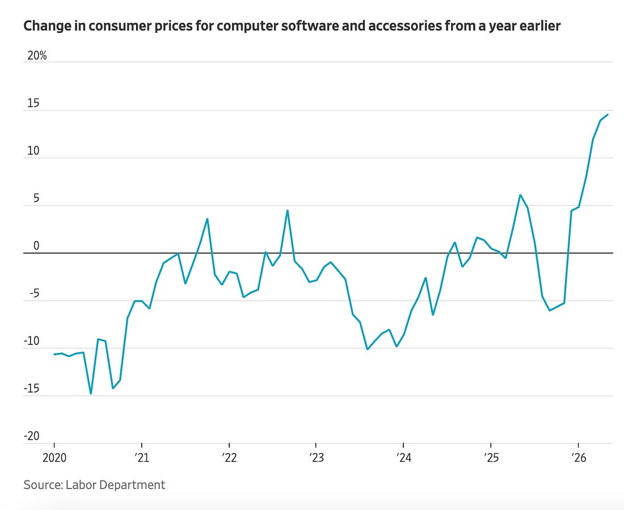
10. These AI-driven memory price increases are now showing up in consumer hardware and Apple recently announced price increases on its products.
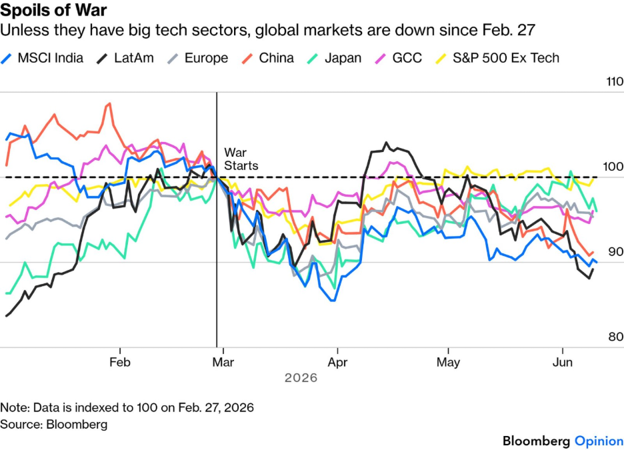
11. Outside of Tech, many businesses are still feeling the inflationary impacts of the Iran war.
12. Demand for AI models appears strong with room for continued adoption
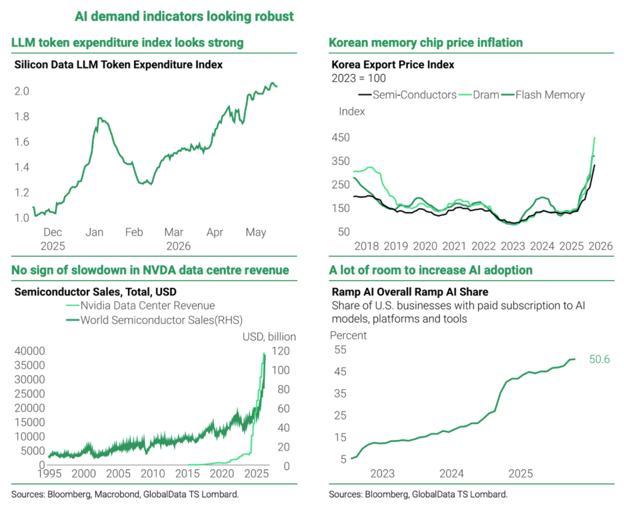 Source: Daniel von Ahlen, TS Lombard via the Daily Chartbook on 6/4/2026
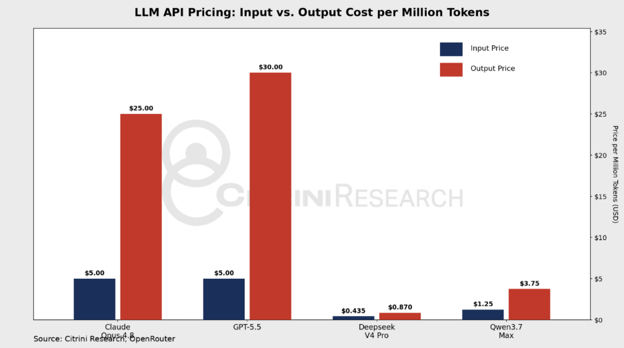
13. How long will US businesses and consumers dedicate most of their AI spend to cutting edge US models when Chinese models continue to improve and offer tremendous relative value.
 Source: Citrini Research via Bloomberg Odd Lots
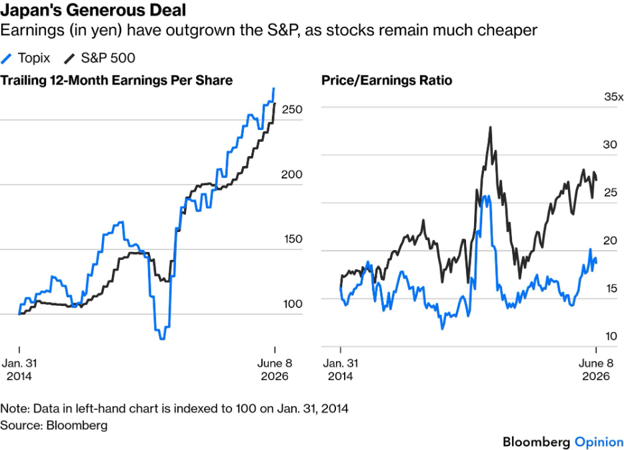
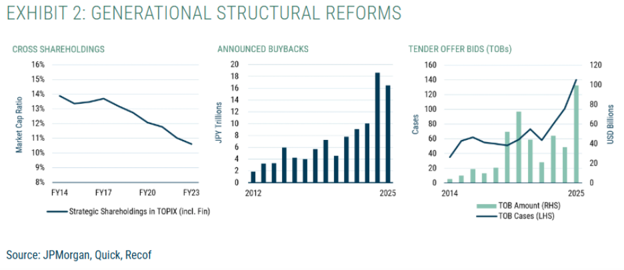
14. Japan’s market strength has been driven by powerful ongoing shareholder-friendly structural reforms which have materialized in better investor returns and still attractive relative valuation
 Source: John Authers, Points of Return
 Source: John Authers, Points of Return
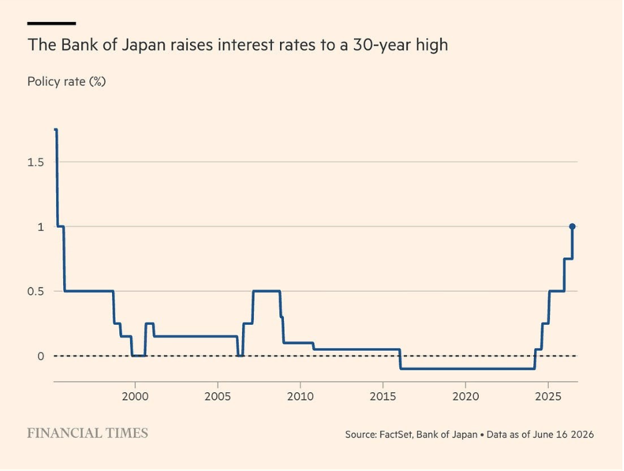
15. Japan appears to have broken through its multi decade trend of a near deflationary economy.
 Source: Financial Times via Chartbook a newsletter from Adam Tooze
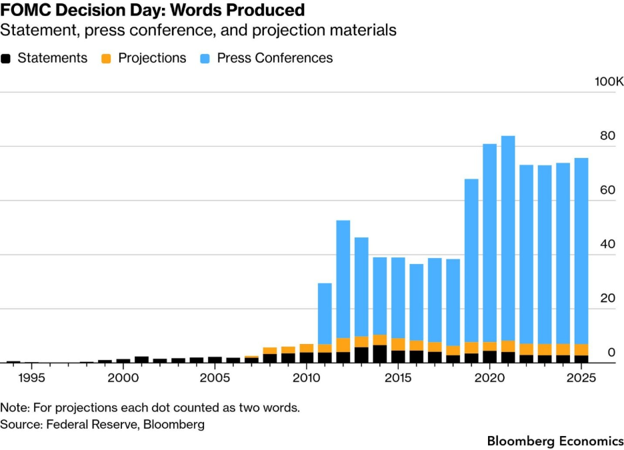
16. If part of the recent Fed Chair’s nomination was due to him being “central casting”, that would align well with how the position has changed over the years.
 Source: Bloomberg Markets Daily
Disclosures:
Copyright © 2026 Algorithmic Investment Models LLC (AIM). All rights reserved. All materials appearing in this commentary are protected by copyright as a collective work or compilation under U.S. copyright laws and are the property of Algorithmic Investment Models. You may not copy, reproduce, publish, use, create derivative works, transmit, sell or in any way exploit any content, in whole or in part, in this commentary without express permission from Algorithmic Investment Models.
Certain information contained herein constitutes “forward-looking statements,” which can be identified by the use of forward-looking terminology such as “may,” “will,” “should,” “expect,” “anticipate,” “project,” “estimate,” “intend,” “continue,” or “believe,” or the negatives thereof or other variations thereon or comparable terminology. Due to various risks and uncertainties, actual events, results or actual performance may differ materially from those reflected or contemplated in such forward-looking statements. Nothing contained herein may be relied upon as a guarantee, promise, assurance or a representation as to the future.
This material is provided for informational purposes only and does not in any sense constitute a solicitation or offer for the purchase or sale of a specific security or other investment options, nor does it constitute investment advice for any person. The material may contain forward or backward-looking statements regarding intent, beliefs regarding current or past expectations. The views expressed are also subject to change based on market and other conditions. The information presented in this report is based on data obtained from third party sources. Although it is believed to be accurate, no representation or warranty is made as to its accuracy or completeness.
The charts and infographics contained in this blog are typically based on data obtained from third parties and are believed to be accurate. The commentary included is the opinion of the author and subject to change at any time. Any reference to specific securities or investments are for illustrative purposes only and are not intended as investment advice nor are they a recommendation to take any action. Individual securities mentioned may be held in client accounts. Past performance is no guarantee of future results.
As with all investments, there are associated inherent risks including loss of principal. Stock markets, especially foreign markets, are volatile and can decline significantly in response to adverse issuer, political, regulatory, market, or economic developments. Sector and factor investments concentrate in a particular industry or investment attribute, and the investments’ performance could depend heavily on the performance of that industry or attribute and be more volatile than the performance of less concentrated investment options and the market as a whole. Securities of companies with smaller market capitalizations tend to be more volatile and less liquid than larger company stocks. Foreign markets, particularly emerging markets, can be more volatile than U.S. markets due to increased political, regulatory, social or economic uncertainties. Fixed Income investments have exposure to credit, interest rate, market, and inflation risk. Diversification does not ensure a profit or guarantee against a loss.
The ISM Manufacturing Index is a monthly survey-based indicator of U.S. manufacturing activity published by the Institute for Supply Management. The BofA Truckload Diffusion Indicator measures the breadth of strength across U.S. trucking volumes based on Bank of America card and logistics data. The MSCI World Value Index tracks large- and mid-cap developed market equities exhibiting value characteristics. The MSCI World Momentum Index tracks developed market equities demonstrating persistent price strength and momentum characteristics. A moving average is a statistical measure that smooths price data by calculating the average value over a specified period. The Russell 3000 Index measures the performance of the largest 3,000 publicly traded U.S. companies representing most of the investable U.S. equity market. The S&P 500 Index measures the performance of 500 large-capitalization U.S. companies. The MSCI Emerging Markets Index measures the performance of large- and mid-cap companies across emerging market countries. Nonfarm Payrolls represent the total number of paid U.S. workers excluding farm employees, government workers, private household employees, and nonprofit employees.
Please contact your AIM Regional Consultant for more information or to address any questions that you may have.
Algorithmic Investment Models LLC (AIM), 125 Newbury St. 4th Floor, Boston, MA 02116 (844-401-7699)