

2Q26 Quarterly Commentary
The second quarter of 2026 stood in stark contrast to the first. Our last letter concluded with our suspicion that markets were looking for a reason to go back up. They found one over and over again with each new announcement of an on-again, off-again ceasefire in the war with Iran. Concerns about oil prices and their potential inflationary impact were quickly cast aside, freeing investors to refocus on AI.
The result was a historically strong quarter for semiconductor stocks. As semiconductors and the factors closely associated with them, such as high momentum and high beta, drew investor attention, the broadening we saw in the first quarter gave way to significant narrowing in the second. Outside of this singular theme, there were few opportunities to outperform the major indices.
Against this backdrop, we have been impressed by our strategies’ ability to generate performance from a differentiated set of positions. We have been encouraged by the results year to date, particularly given that they were achieved without significant exposure to what we view as the biggest risk in global equity markets.
Although our strategies were not positioned for the sudden shift in sentiment in April, they held their ground more steadily as the quarter progressed. After a historically active first quarter, trading was relatively muted in the second. Our models generally held firm, neither chasing the highest-momentum sectors nor retreating from their consistent, albeit reduced, energy exposure.
The Growth strategy benefited most from the quarter’s risk-on sentiment and continues to hold a substantial lead over both its asset-allocation benchmark and global equity indices for the year. The Moderate and Conservative strategies held fewer higher-risk positions and gave back more ground, but each also remains ahead of its asset-allocation benchmark.
All three strategies maintained above-neutral equity exposure during the quarter, but the market’s narrow leadership made it difficult to fully capture index gains. Weakness in energy and natural resources was the primary headwind, while limited AI exposure also weighed on relative performance.
For most of the quarter, we held a fairly eclectic mix of equity sectors. These positions are often volatile individually but were not highly correlated with market indices or with one another, nor were they representative of the prevailing AI trade. This diversification allowed us to hold additional equity exposure while keeping overall portfolio volatility in check.
Japan and Biotech were substantial positive contributors across all three strategies. The Growth strategy also benefited from indirect AI-infrastructure exposure through Clean Energy, as well as another esoteric winner in China A-shares.
AI supplier sentiment hits a “fever pitch”. AI stocks driving the recent market rally look increasingly risky.
Semiconductors marched steadily higher through April, but volatility increased over the remainder of the quarter, ultimately reaching a fever pitch as moves of several percentage points in either direction became the norm.
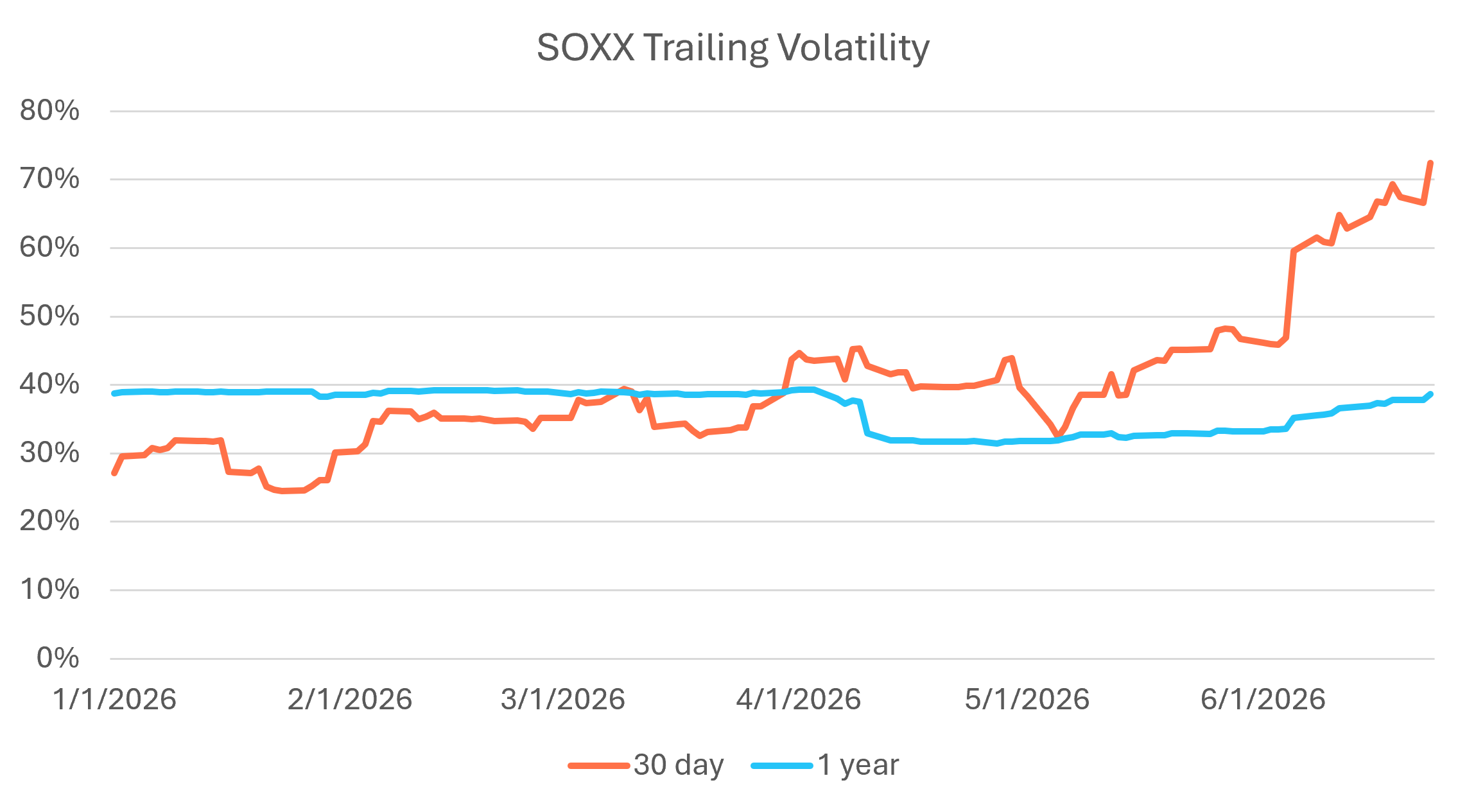 Source: Bloomberg, iShares Semiconductor Index, 12/31/2024 through 6/30/2026
Strong returns can come on the back of high volatility, but that volatility more commonly follows a large drawdown or market pivot. What is particularly unusual about the current environment is how many assets are exhibiting high volatility while sitting close to all-time highs.
Within our pool of ETFs, the only situation similar to this one occurred during the final run-up of the tech bubble, notably the only period where the spike preceded the market drawdown rather than represented its recovery.
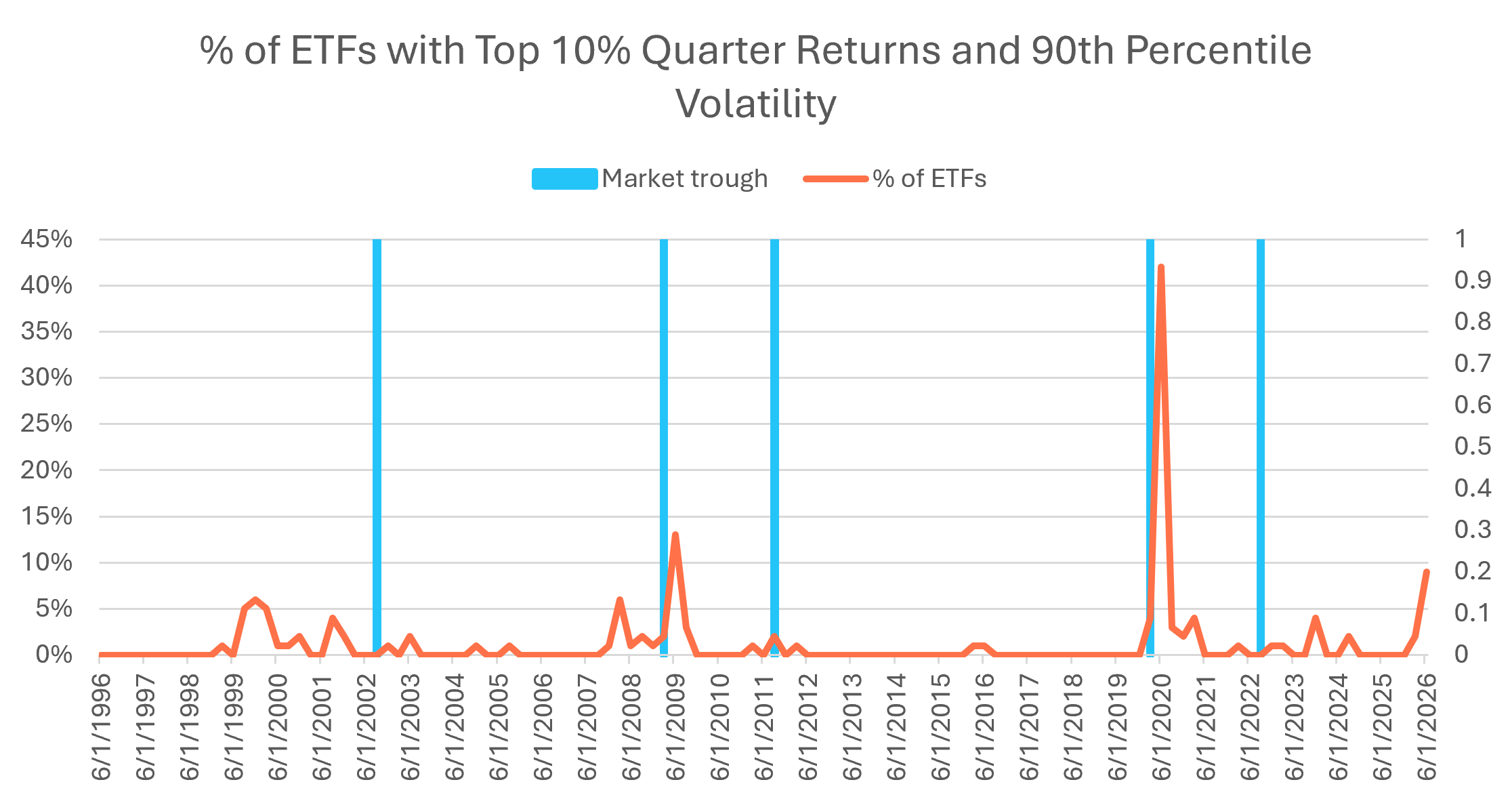 Source: AIM data, Bloomberg data for market toughs. Data is for a trough on a larger than 20% drawdown in the S&P 500
While volatility may not be a risk itself, it does create a less favorable distribution of outcomes. For the semiconductors sector in particular, the current setup of high volatility within 10% of an all-time high has yielded negative returns on average[1].
Historically, most large market drawdowns have followed an uptick in volatility. It is worth noting, however, that the same conditions are not present today. While volatility among AI-related equities increased markedly, volatility for the average S&P 500 stock did not. This likely explains why our rankings favor equities while avoiding the AI-related high-fliers that appear uniquely risky at the moment.
Our portfolio changes at the end of the quarter removed some of our riskiest positions and lowered portfolio beta, despite maintaining or slightly increasing overall equity exposure. We would normally view this repositioning as defensive, but overall equity exposure remains high. Instead, there may simply be some opportunity in good, but less exciting businesses that have been overlooked amidst investors’ lust for AI exposure.
The Claude Catalyst
The rise of Anthropic and its chatbot, Claude, was at the center of an acceleration in AI spend which drove the historic stock performance of AI suppliers. The quarter fittingly culminated with SpaceX’s record-setting initial public offering (IPO)—which raised $75 billion at a nearly $2 trillion valuation—bolstered by the newly promoted prospect of putting datacenters in space.
Needless to say, investor risk appetite is responsible for a large portion of AI-related market performance. However, a true increase in AI related demand kicked off the run.
On February 5th, Anthropic released a new model, Claude Opus 4.6. The update made Claude far more capable as a coding tool and introduced teams of “AI agents” to work in parallel on complex tasks at a user’s direction. Claude quickly became extremely popular and, in recent months, Anthropic was widely viewed as the leading AI lab, a position subsequent updates have only strengthened.
What followed was a series of large fundraisings, to capitalize on the success, and a wave of new demand for which Anthropic was unprepared. Amongst this fundraising the company disclosed an annualized revenue run-rate of $47 billion[2], roughly five times where it stood at the start of the year. To meet this demand, Anthropic signed agreements that increased its contracted compute commitments roughly tenfold.
This demand landed on top of an already tight market for AI hardware, creating a classic supply-and-demand mismatch. GPU rental prices, which typically decline over time as a particular model family depreciates, instead soared.
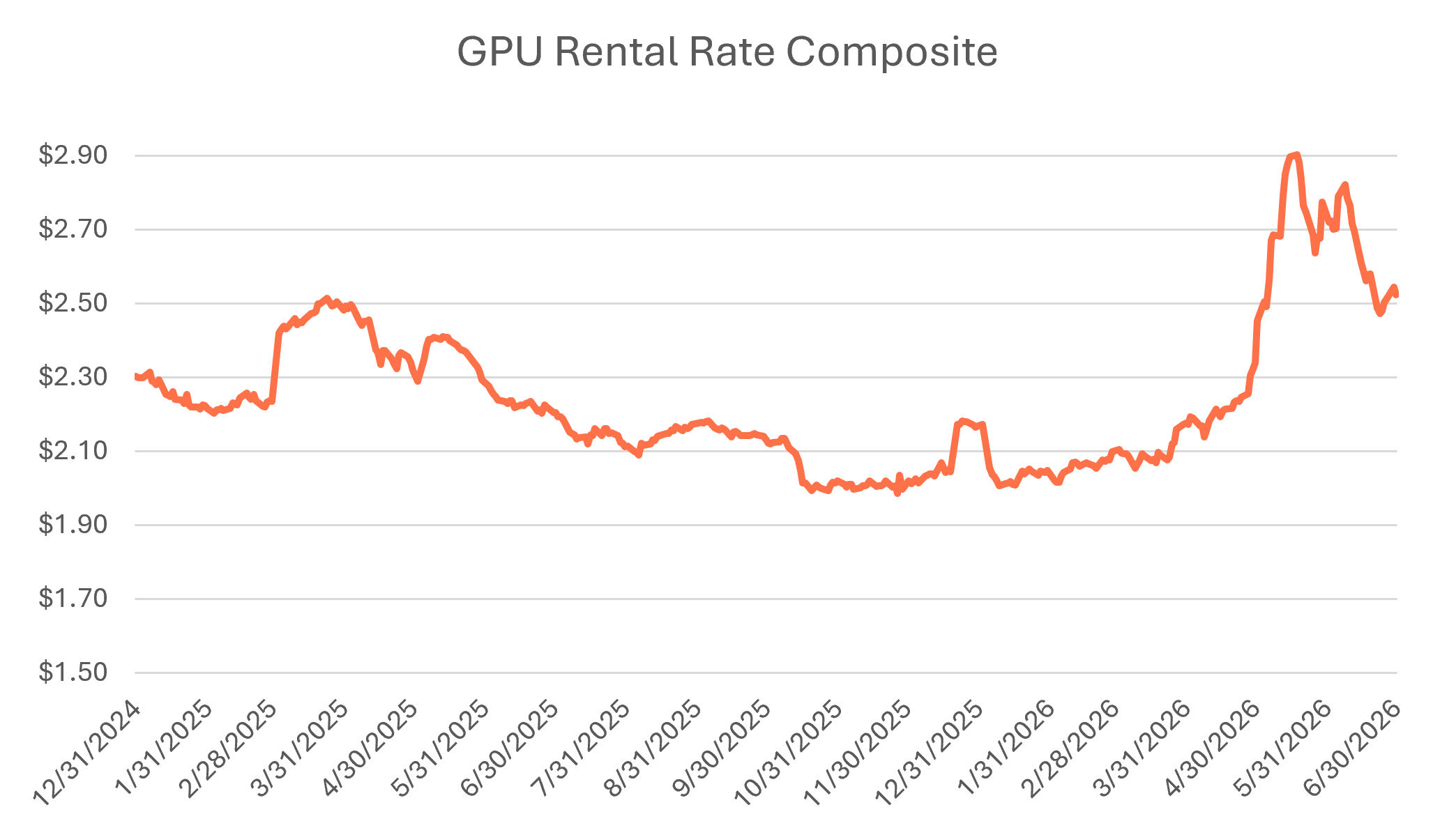 Source: Bloomberg, average of Silicon Data H100 index, Compute Desk Hopper US Index, and Ornn Compute H100 Index. 12/31/2024 – 6/30/2026
The most notable “bottleneck” became memory chips. The three major suppliers of high-bandwidth memory, the kind required for AI data centers, are Micron, Samsung, and SK Hynix. These companies were able to more than double prices per unit of memory and, in the recent quarter, saw their combined profits increase nearly tenfold (963%) to $96 billion[3].
For reference, the top five largest AI hyperscalers (Amazon, Google, Microsoft, Meta, and Oracle) spent about $150 billion on cap-ex in the same quarter. Goldman Sachs expects U.S. AI investment to reach $765 billion in 2026[4]. Pure price increases from memory companies are now consuming a large amount of the total spend, a factor that will necessarily force returns on investment lower.
With all three of these companies’ market cap are at or near a trillion dollars, many times levels from just a year ago, investors have been rewarded for the windfall. A windfall that came directly out of the pockets of the biggest AI buyers.
We view this as further evidence supporting our thesis that AI is catalyzing a major increase in competition amongst the largest U.S. tech platforms, which achieved their historic past success as near-monopolies within their respective verticals.
AI supply remains a key focus for markets, and it will be difficult to scale the supply of components, such as memory, quickly enough to meet current levels of demand (although like the all-female dinosaurs in Jurassic Park, capitalism historically “finds a way”[5]).
The key assumption is that demand itself has not been temporarily boosted by “Claude-fever.” Many companies were eager to experiment with the models and, in some cases, even incentivized their engineers to use as much compute as possible. Initially, few companies fully appreciated the costs associated with deploying these models at scale. In one notable example, a company (seemingly Amazon) reportedly spent $500 million on Claude in a single month[6]. Uber famously blew through its entire annual AI budget a few months into the year.[7] While long-term demand seems likely to be enormous, supply could still outpace near-term adoption as implementation becomes the next bottleneck and corporations are forced to scale their AI usage gradually and profitably.
Investors remain complacent around global oil supply. Oil continues to provide powerful portfolio benefits.
Despite the fragility of the U.S.-Iran ceasefire, markets became increasingly confident that both parties were incentivized to get oil flowing through the Strait of Hormuz as the quarter progressed. Oil prices fell below their pre-war level at times, and energy companies performed poorly during the quarter.
From a fundamental standpoint, oil now looks like a fairly cheap hedge. Energy equities are already discounting lower oil prices, but the companies should continue to make excess profits as long as oil remains elevated in the near term. The longer any sort of conflict continues, the more valuable that hedge should become. Thus far, the disruption to tanker traffic through the Strait does not appear to have been meaningfully alleviated.
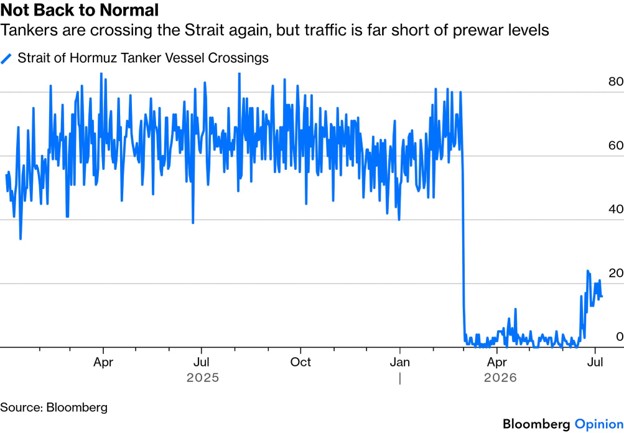 As of July 8th, 2026
More important for our quantitative models, energy and commodities continue to offer attractive portfolio characteristics. Their correlation with broad equities remains low, even negative at times, while fixed income, the typical hedge for equity risk, has continued to offer very little protection or return. We expect these conditions to persist as long as inflation is viewed as a greater risk to the economy than slowing growth. These diversification benefits likely allow our models to maintain more equity exposure than they might otherwise.
Can we continue to broaden?
We have long anticipated (and wished for) broader equity market participation. With a wide range of investment options at our disposal, a broader opportunity set should allow us to add more value relative to historically concentrated market indices. While this quarter was a minor setback from that perspective, encouraging signs remain. International equities have continued their trend of outperformance that began near the end of 2025, while the recent surge in momentum and higher-beta equities (both piggybacking off the semiconductor stocks) appears due for some sort of mean-reversion.
The high volatility we’ve seen in these securities is akin to driving a car on the highway with a vibrating driveshaft: you must either slow down or you will eventually break down. If volatility subsides, perhaps our models will find their way back into semiconductors or other AI-related high-beta sectors. If it does not, we expect there will be some pain in the sector that could spill into broad market indices, given how large these securities have become. In that case, we will be glad to have very little direct exposure to the group.
While there have been massive fundamental developments within the AI ecosystem, we believe a large portion of the recent run has been due to FOFB (fear of falling behind) among investment managers who are under-exposed to the group. Many of these managers may now find themselves benchmarked against an index that could be well over 20% semiconductors. A large influx of new buyers is a hallmark of high performing, volatile sectors and often leaves plenty of weak hands when tide turns.
We are comfortable with our diversified and, we believe, relatively defensive positioning within equities. In a year when risk has been handsomely rewarded, we are extremely pleased that our strategies remain ahead of their benchmarks while maintaining limited exposure to the increasingly concentrated and volatile AI trade. Thank you for your continued trust and business.
Download the PDF version here.
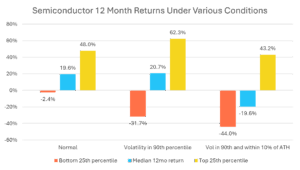 Source: Bloomberg data GICS Semiconuctors sector 12/31/89 – 6/30/2026
[2] Mid-May disclosure
[3] Per company filings, where applicable profits based on specific memory unit disclosures. For Micron reference period is 2/28/2026 through 5/31/2026, for SK Hynix and Samsung reference period is 12/31/2025 through 3/31/2026. Each represents the most recent available data.
[4] Total of the 5 companies in the most recent reported quarter was $147B per company fillings. Goldman Sachs figure: https://www.goldmansachs.com/insights/articles/tracking-trillions-the-assumptions-shaping-scale-of-the-ai-build-out
[5] While the big three memory suppliers cannot likely bring enough new supply to market to oversupply current demand in the next few years, Chinese firms are eagerly entering the market and any technological innovation in the implementation of AI models which reduces their memory demands could alleviate the shortage quickly.
[6] https://finance.yahoo.com/sectors/technology/articles/mystery-company-accidentally-blew-500-094401679.html
[7] https://finance.yahoo.com/technology/ai/articles/uber-blew-entire-2026-ai-145000897.html